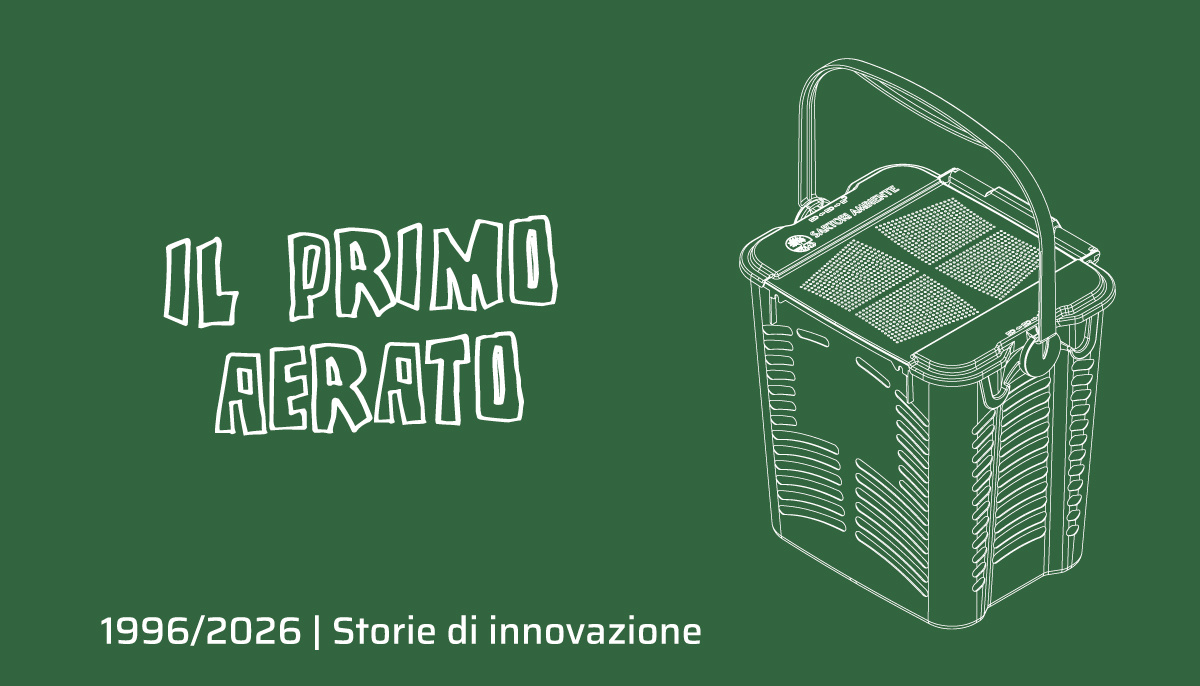
In 2003, Sartori Ambiente took a key step in the development of solutions for separate waste collection with the introduction of Stelo, the first aerated container for organic waste collection.
At the time, door-to-door collection systems were rapidly expanding, along with growing attention to composting and the valorization of organic waste. However, field experience highlighted a recurring issue: the use of traditional containers led to high moisture levels in the waste, with direct consequences on the quality of the collected material and the efficiency of the service.
Organic waste was heavier, prone to unwanted fermentation, with the formation of leachate and odors that affected both the experience of citizens and the working conditions of operators.
It was in this context that Stelo was born.
The design insight was as simple as it was innovative for its time: to promote the natural ventilation of organic waste through an aerated structure capable of reducing excess moisture and improving the overall management of the fraction.
The benefits proved immediate and measurable:
• reduction of leachate
• decrease in odors
• lighter waste at disposal
• improved quality of the organic fraction sent for treatment
Field tests and real-world applications showed that the use of aerated systems can significantly reduce the weight of organic waste, contributing not only to improved user comfort but also to the optimization of logistics and treatment processes.
Over time, this principle has become firmly established as a benchmark in the design of systems for organic waste collection. Aeration is no longer an optional feature, but a structural component to ensure quality, efficiency, and sustainability across the entire value chain.
From this innovation, a true evolution of solutions has emerged, leading to the development of increasingly high-performance, ergonomic containers that can be seamlessly integrated into modern collection models, helping to improve service quality and separate collection results.
Stelo therefore represents much more than a product: it marks the beginning of a new way of designing, where the container is no longer a passive element, but an active tool that interacts with waste, influences its behavior, and improves its management.
An idea born in 2003 that continues to drive innovation today, in a journey that combines design, research, and a concrete focus on the needs of citizens and operators.
Happy anniversary to Sartori Ambiente.