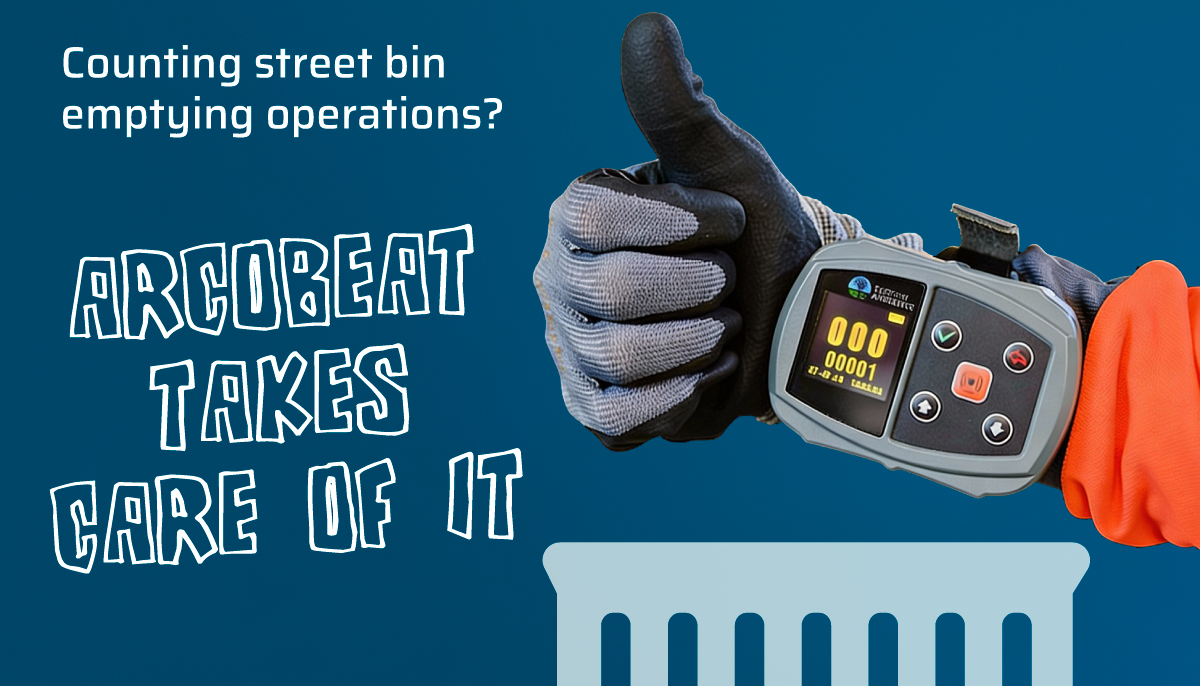
In the day-to-day work of urban hygiene services, there are essential activities that often remain invisible precisely because they work well. The emptying of street litter bins is one of these: a repetitive activity, widespread across the territory, essential for urban cleanliness, yet traditionally difficult to describe and demonstrate through objective data.
It is in this context that CIDIU decided to take a step further, seeking a tool capable of making measurable and verifiable a service that, until recently, had been reported almost exclusively on the basis of planning.
The choice fell on ArcoBEAT, the wearable portable reader by Sartori Ambiente, created for tracking emptying operations in door-to-door collection.
In this project, however, ArcoBEAT takes on a different role: it is not used to measure a waste disposal event, but to certify an activity carried out in the field.
Each street litter bin is equipped with an RFID TAG that makes it uniquely identifiable. During emptying, the operator wears ArcoBEAT. The reading takes place naturally, without interrupting the work gesture, and is automatically associated with date, time, and GPS position. In this way, each operation leaves a simple yet robust digital trace.
The value of the solution lies precisely here: technology does not change the service—it supports it. It introduces no additional steps, does not slow down operations, and does not complicate the operators’ work. On the contrary, it makes it possible to collect data that previously did not exist or was fragmented.
For CIDIU, this means having reliable information on when and where bins are actually emptied, allowing a comparison between the planned service and what is effectively carried out. It provides concrete support for reporting to the public administration and a useful tool for monitoring service levels and optimizing emptying frequencies.
The project shows how ArcoBEAT can go beyond the traditional boundaries of waste traceability, becoming an enabler of measurable services. Not just collection, but service quality, transparency, and trust.
In this sense, the experience with CIDIU clearly reflects Sartori Ambiente’s approach: developing tools designed for real urban hygiene operations, capable of adapting to different contexts and delivering data, simplicity, and operational value even in services that, until yesterday, could not be measured.