Inclusivity is not an added detail to products: it is one of the principles that has guided Sartori Ambiente’s research and design activities for many years. In the waste-management sector, ensuring accessibility means enabling people to take an active role in separate waste collection in a simple and safe way. This is a long-standing commitment for the company, which has led to solutions now recognised at both national and international level.
Sartori Ambiente’s path towards inclusivity took concrete shape in 2012, when the Municipality of Forlì launched door-to-door waste collection and was faced with a clear question raised by the Italian Union of the Blind and Visually Impaired: how can blind or visually impaired people independently recognise separate-collection containers?
The answer emerged from a joint working group involving the local authority, sector operators, representatives of associations and specialised technicians. From this dialogue came a system of tactile symbols designed according to the principles of Design for All, a concept that would be formally defined a few years later by ISO 24507:2021, the standard dedicated to tactile and visual elements that promote universal understanding.
The symbols integrate two components:
-
a raised pictogram, easily perceivable by touch and consistent with the type of waste
-
the initial letter in Braille, chosen from those most widely recognised internationally.
This approach makes it possible to overcome a fundamental limitation: not all people with visual impairments read Braille, whereas an intuitive tactile element can be immediately recognised by anyone. Dimensions, thicknesses and spacing are optimised through multiple tactile tests to ensure full legibility.
The most significant choice comes at the adoption stage: all citizens receive containers with tactile symbols, not only those who strictly need them.
A decision that transforms a specific requirement into an educational opportunity, also adopted in schools through workshops dedicated to “in-the-dark” separate waste collection.
Today, this decision is perfectly aligned with the requirements of the European Accessibility Act (EU Directive 2019/882), which came into force in Italy in 2025 and requires products and services intended for the public to meet universal accessibility criteria.
The experience gained with tactile symbols has not remained an isolated episode. Over the years, Sartori Ambiente has extended the Design for All approach across its entire product range.
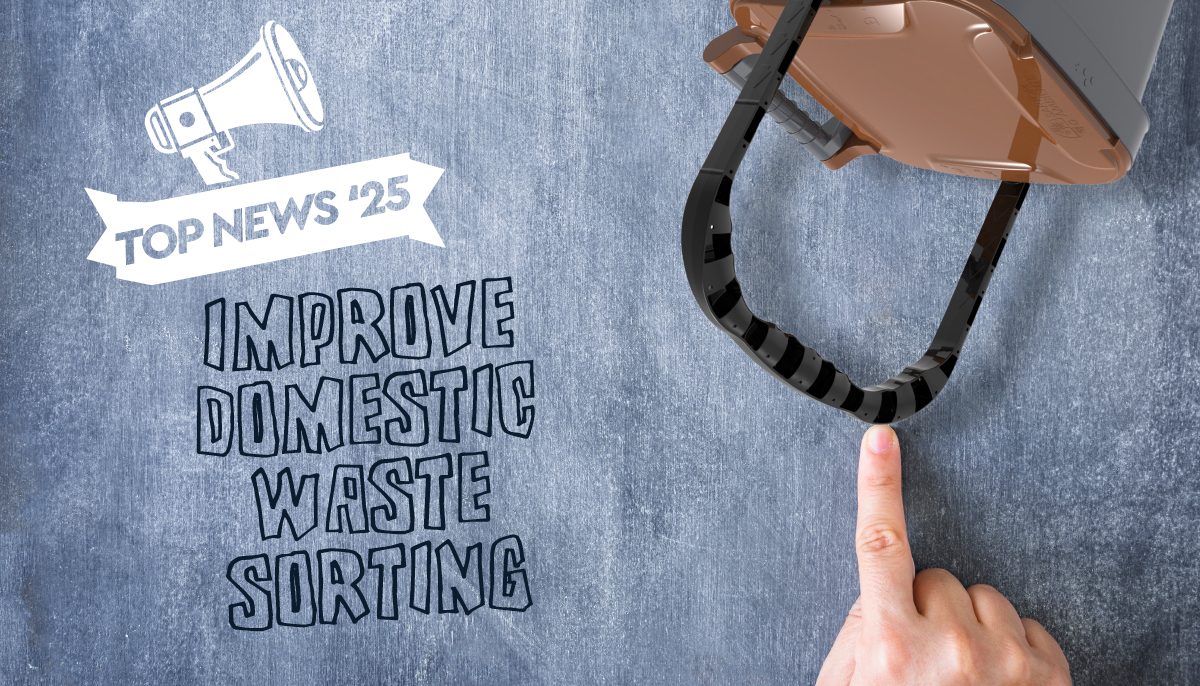
The most emblematic example is UrbaE, the first waste-collection container to be certified Ergocert 4-star and designed in accordance with person-centred design principles (ISO 9241-210).
The goal: to enable waste-collection operators to work with less physical strain, lower risk of injury and greater operational effectiveness.
Its features include:
- an ambidextrous ergonomic handle with three grip points
- multiple lower grips that improve lifting ergonomics
- optimised geometries to reduce effort during repetitive movements
- a design process verified and certified through the Human-Centered Design methodology.
In this way, inclusivity takes on a broader meaning: it concerns not only citizens, but also those who ensure the daily operation of public services. Sensory accessibility and professional ergonomics become two sides of the same mission: creating tools that respect people and make their work easier.
Whether it is a tactile marker, an ergonomic handle or an opening system designed to be used by everyone, the goal remains the same: to make waste collection a truly accessible, safe and diversity-respecting service.
A commitment that continues to guide Sartori Ambiente today as it did in the past, fostering innovations that place what truly matters at the centre: people.